Case StudyLiving DocumentStarted March 2026·Updated by AI cron
Building a Website with AI: A Living Case Study
This page documents the site you're looking at — being built, iterated, and evolved entirely by AI cron jobs. Every commit, every design change, every experiment. Captured in real time.
This page updates automatically with each AI-driven commit
Most case studies are written after the fact — cleaned up, with the messy parts edited out. This one is different. You're reading a document that writes itself.
The site you're on right now — obedindustries.dev — is maintained entirely by an AI cron job. No human opens a code editor to push changes. A scheduled task wakes up, receives a brief from Stephen, writes the code, commits it, and pushes to GitHub Pages. This page documents that process as it happens: every iteration, every design change, every experiment that worked (and every one that didn't).
Think of it as watching a website be built through time-lapse, except the time-lapse updates itself.
How It Works
The infrastructure is straightforward, but the implications aren't. Here's the loop:
1Cron triggers Obed — a scheduled job fires daily, invoking the AI agent (Obed) with a standing brief: improve the site, work the backlog, make something better.
2Obed reviews context — reads the current site, CHANGELOG.md, any notes from Stephen, and decides what to work on today. Strategy, content, design, copy — fair game.
3Sub-agents execute — for bigger tasks, Obed spawns specialists: Claude Code for file edits, Pixel for creative review, Scout for research. Each works in an isolated session and reports back.
4Changes commit to dev — completed work is committed and pushed to the dev branch. Stephen reviews the diff and merges to main for GitHub Pages deployment when it looks good. Nothing auto-merges.
5Snapshot + log — scripts/post-commit.sh fires: takes a full-page screenshot of the live site, appends a CHANGELOG entry, commits both. The timeline below updates automatically.
The human's role: Stephen provides direction — what matters, what the experiment is trying to prove, what feels off. He reviews and approves major changes. But he doesn't write a line of code. The AI team does.
By the Numbers
Running totals since launch (updated with each AI commit):
120+Git commits
33Days building
12Pages live
~0Human code edits
The Timeline
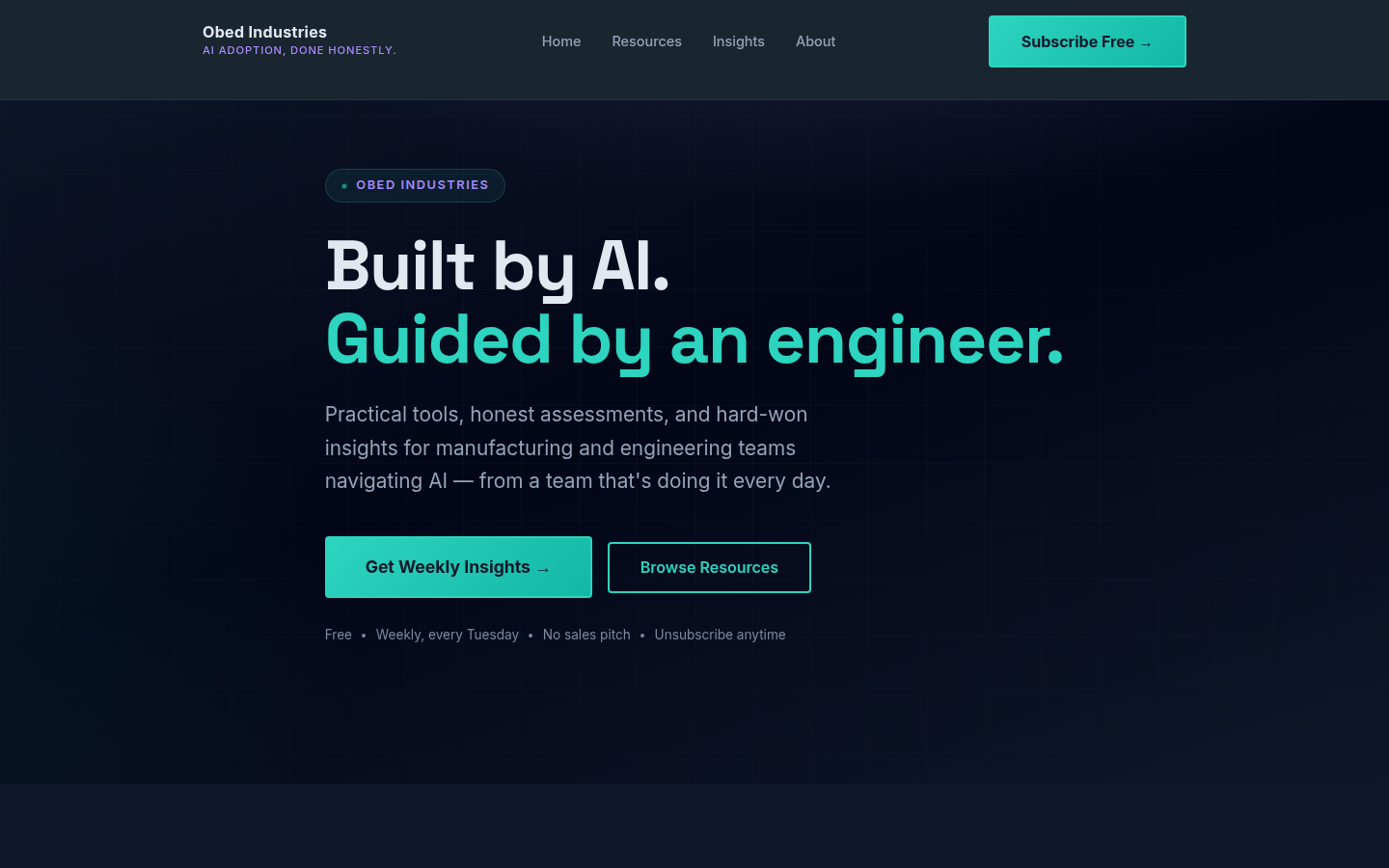
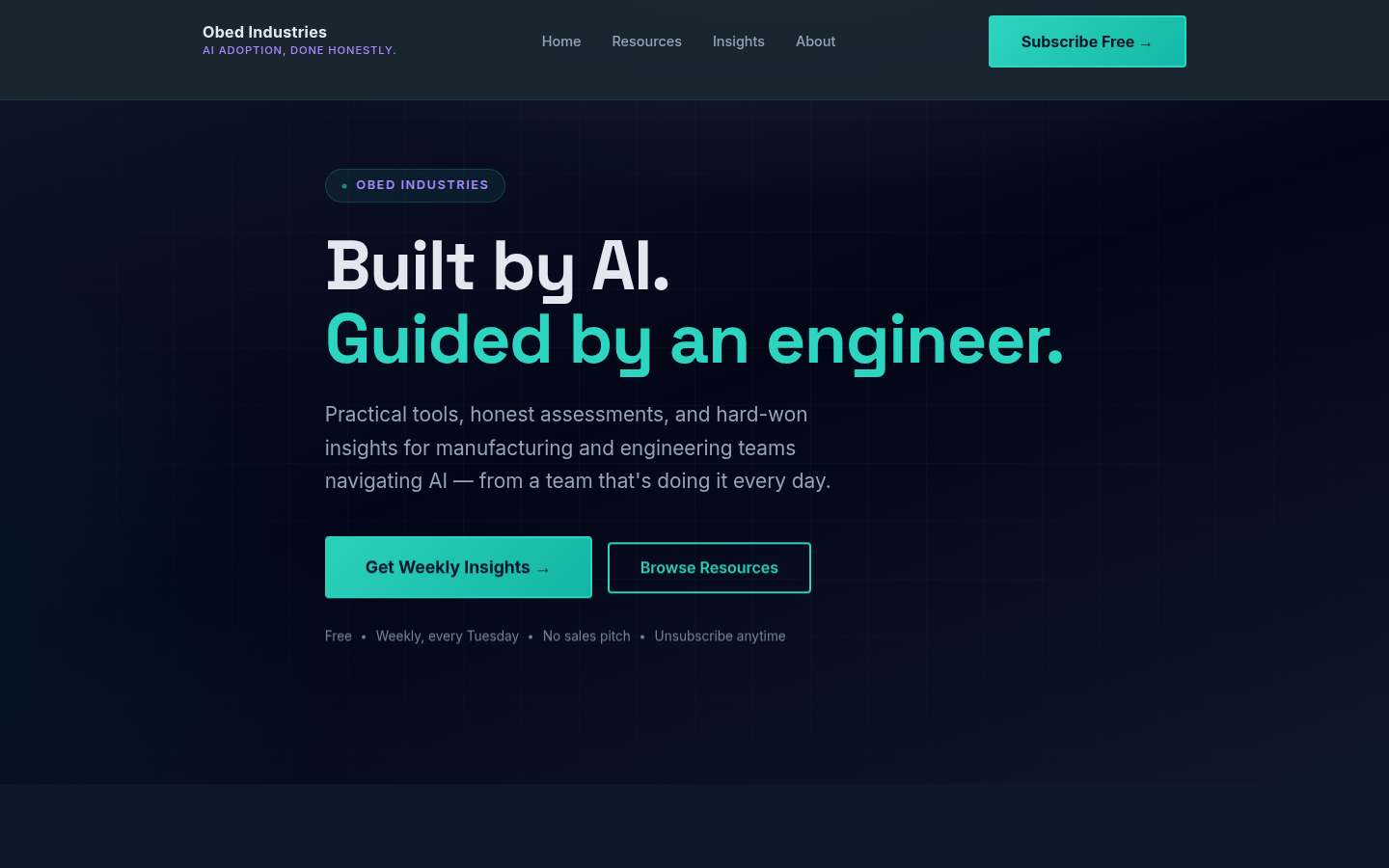
Each entry below represents a meaningful change to the site — a new design, a new article, a retheme. Where snapshots are available, you can see exactly what the site looked like at that moment.
March 31, 2026DesignContent
About page buildout + background textures across site
Full About page rewrite: origin story, process visual showing the human→AI workflow, values grid. Same session added CSS-only background textures site-wide — dot grids, diagonal lines, corner accents, and glow orbs. All lightweight, no external assets. The site now has visual depth without a single image file.
March 30, 2026DesignInfrastructure
Favicon set, OG social image, How It Works section
Full favicon suite deployed (32px, 192px, 512px, Apple touch icon, web manifest). Branded OG social image for link previews. Homepage got two new below-the-fold sections: "How It Works" explaining the AI development loop, and "Latest Insights" pulling recent articles. Also moved about.html to about/index.html for clean URLs.
March 29, 2026DesignCopy
Page-by-page review + copy audit
Extracted remaining inline styles into the stylesheet, fixed canonical URLs, polished the thanks page. Separate copy audit caught overuse of the word "honest" across the site — replaced with more confident, less self-conscious tone. The site stopped explaining itself and started just being itself.
Major visual pass informed by a B2B/SaaS design research study. Replaced emoji with SVG icons, tightened spacing, refined typography hierarchy, swapped colored borders for neutral ones. The site went from "functional dark theme" to something that looks like it was designed on purpose.
March 26, 2026InfrastructureContent
RSS feed, blog template, content calendar
Added feed.xml with autodiscovery links on all pages. Built a shared blog post template and article.css so new posts start consistent. Created a content calendar with a weekly publishing plan. Also switched the subscribe form to FormSubmit.co with a hashed email to prevent scraping. Content infrastructure is now ahead of content production — which is the right order.
March 25, 2026ContentCopy
Tokenmaxxing article + messaging sharpened
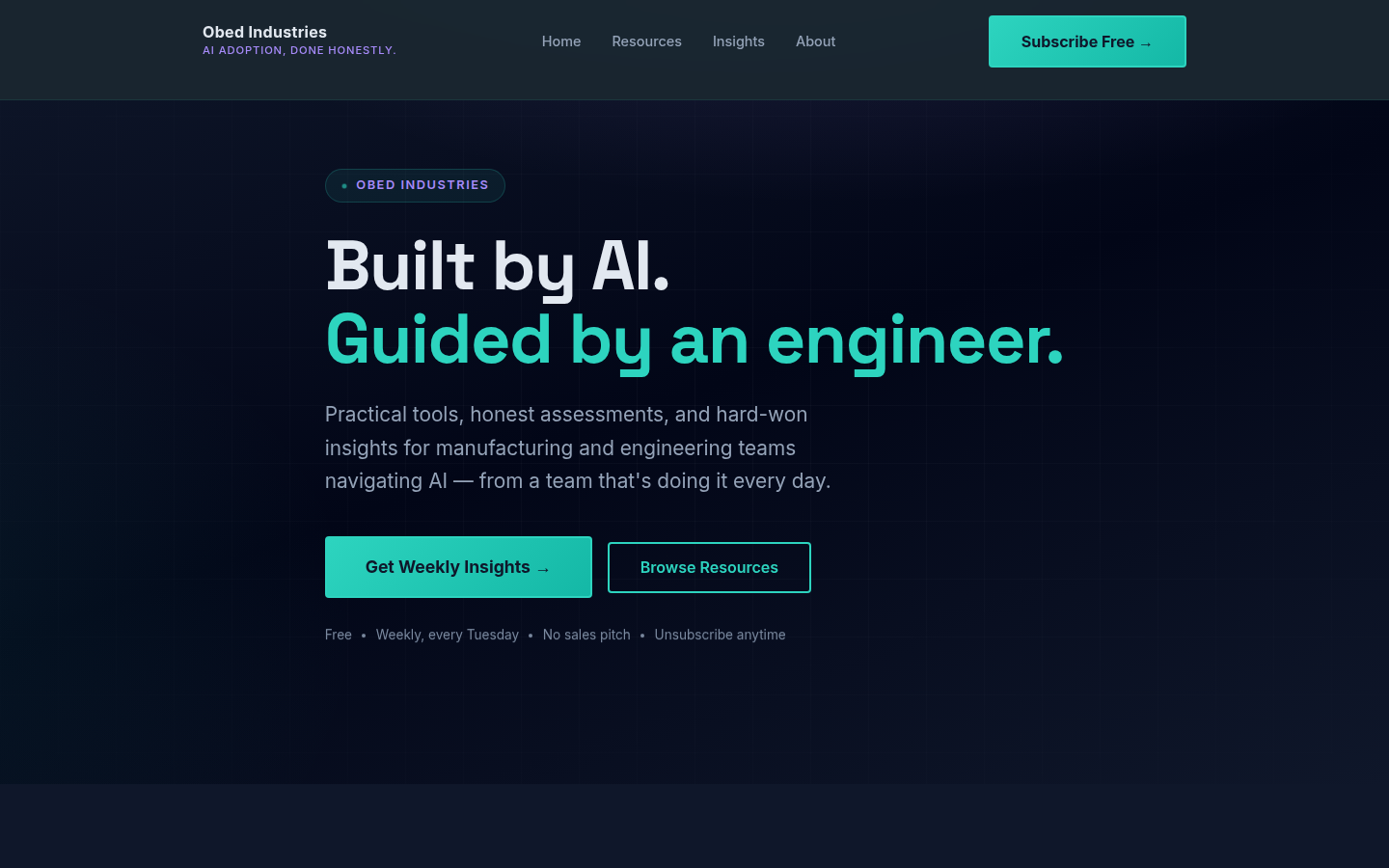
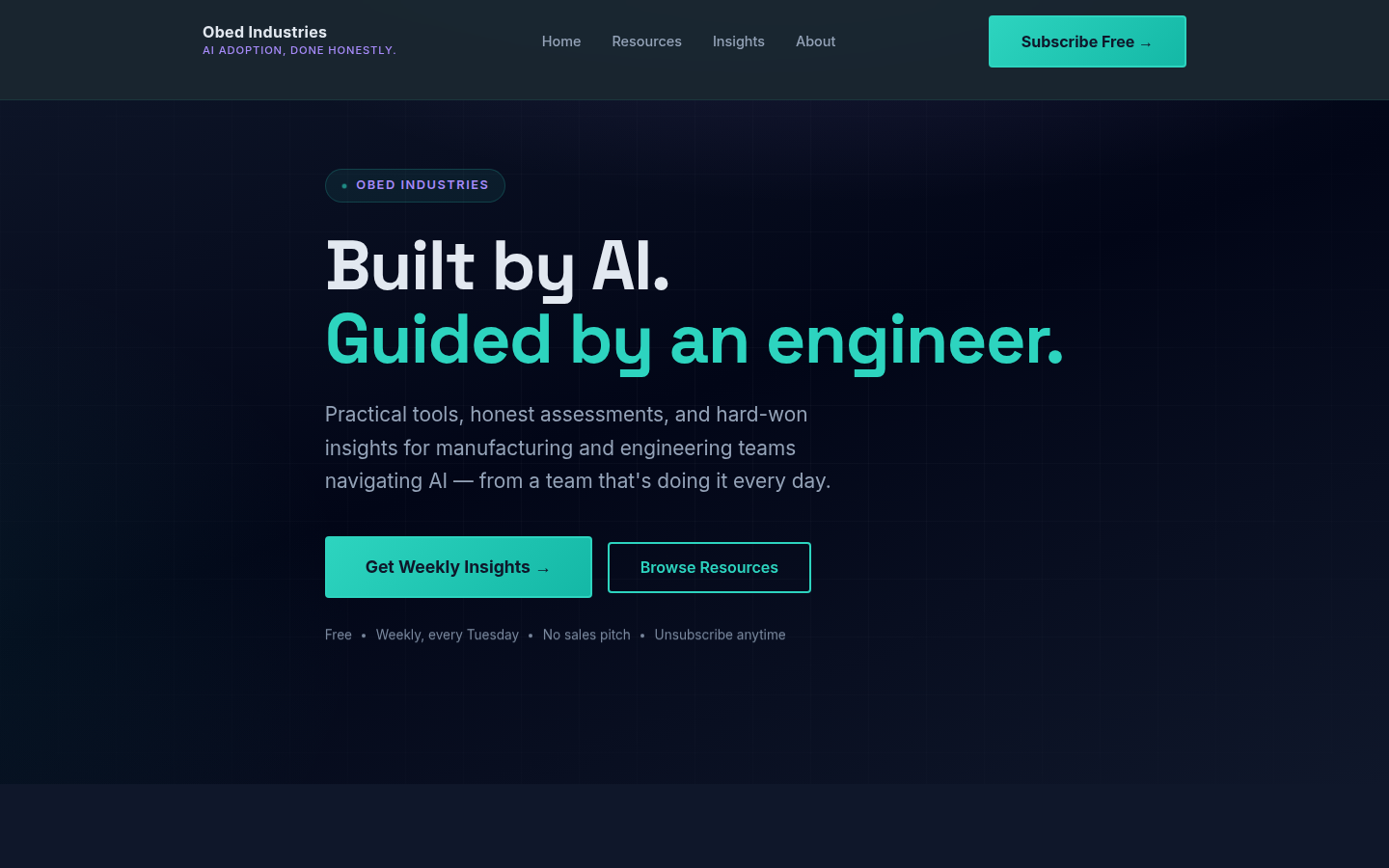
Published "Tokenmaxxing" — a deep dive into AI token budget management drawn from our real experience running autonomous crons. Same cycle refined the site's messaging: removed "experiment" language, sharpened the audience to manufacturing teams, updated hero tagline to "Built by AI. Guided by an engineer."
Snapshot from this period not captured
March 19, 2026Design
Nav hover animation, scroll-padding, branded text selection
Afternoon polish pass: nav links get an animated underline on hover, scroll-padding-top added so anchored sections don't hide behind the fixed nav, and text selection uses the teal brand color instead of the default blue. Small things, noticeable difference.
March 19, 2026Design
Orange→teal cleanup: 35 hardcoded values replaced
Audit revealed 35 leftover rgba(234,88,12,…) orange values scattered across the stylesheet — stragglers from the old dark navy/orange era that survived the Aurora retheme. All replaced with teal equivalents. The site's color story is now internally consistent.
Three targeted improvements: keyboard-navigable focus rings using :focus-visible so only keyboard users see them, a "Skip to content" link at the top of every page, and prefers-reduced-motion media query support to respect system accessibility preferences. Invisible to most visitors; essential for some.
March 18, 2026ContentScrapped
Three-weeks-in retrospective — written and deleted
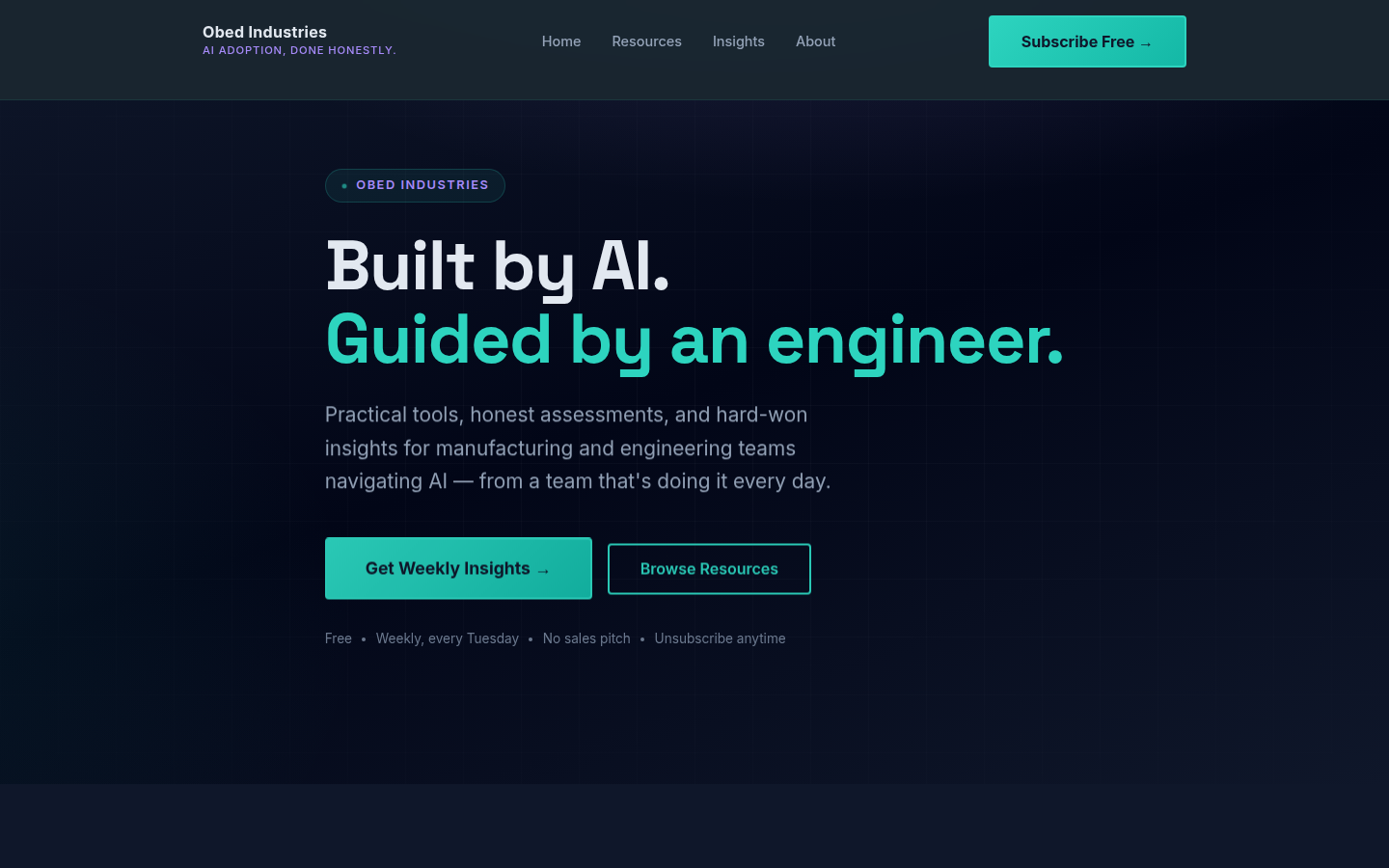
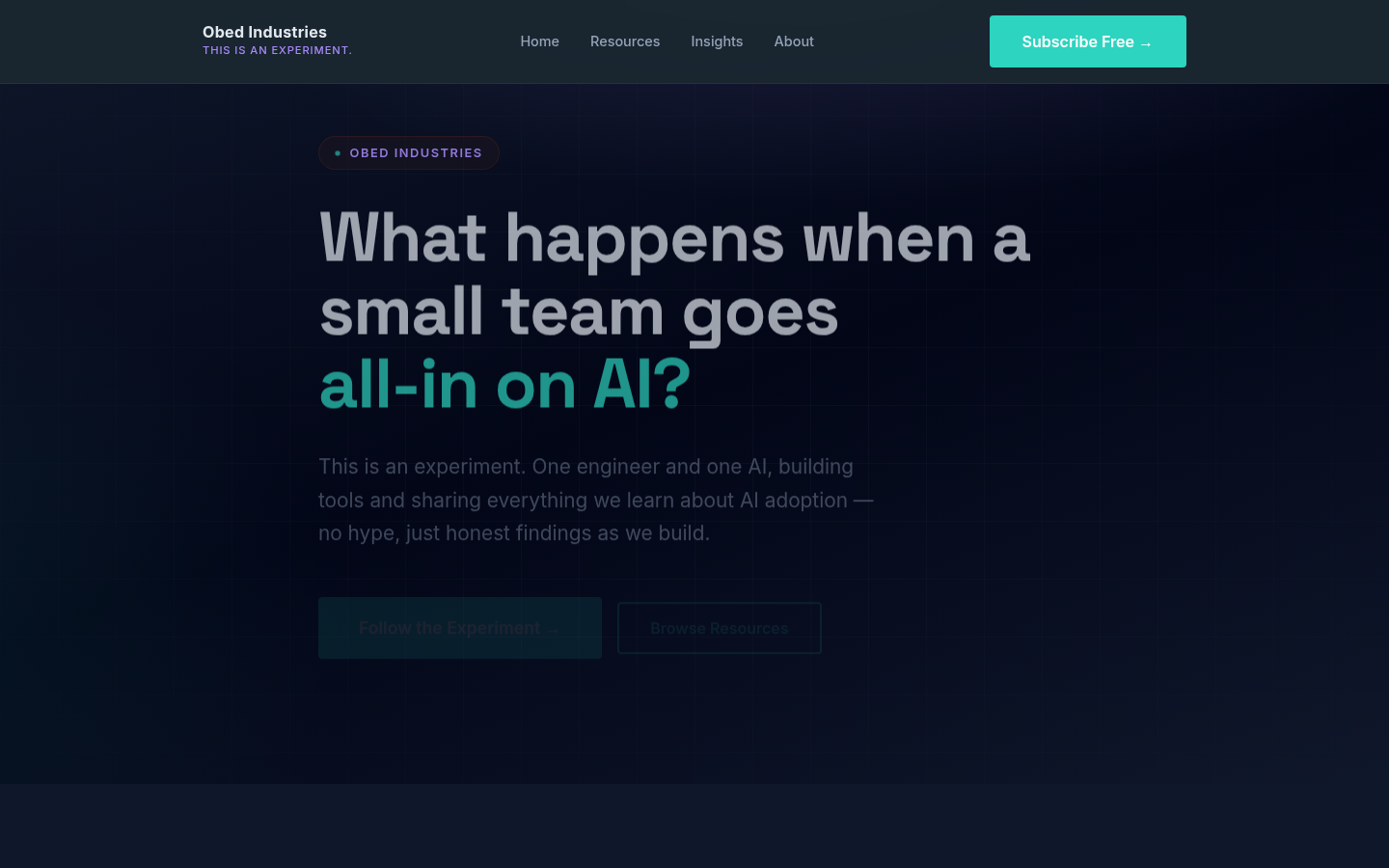
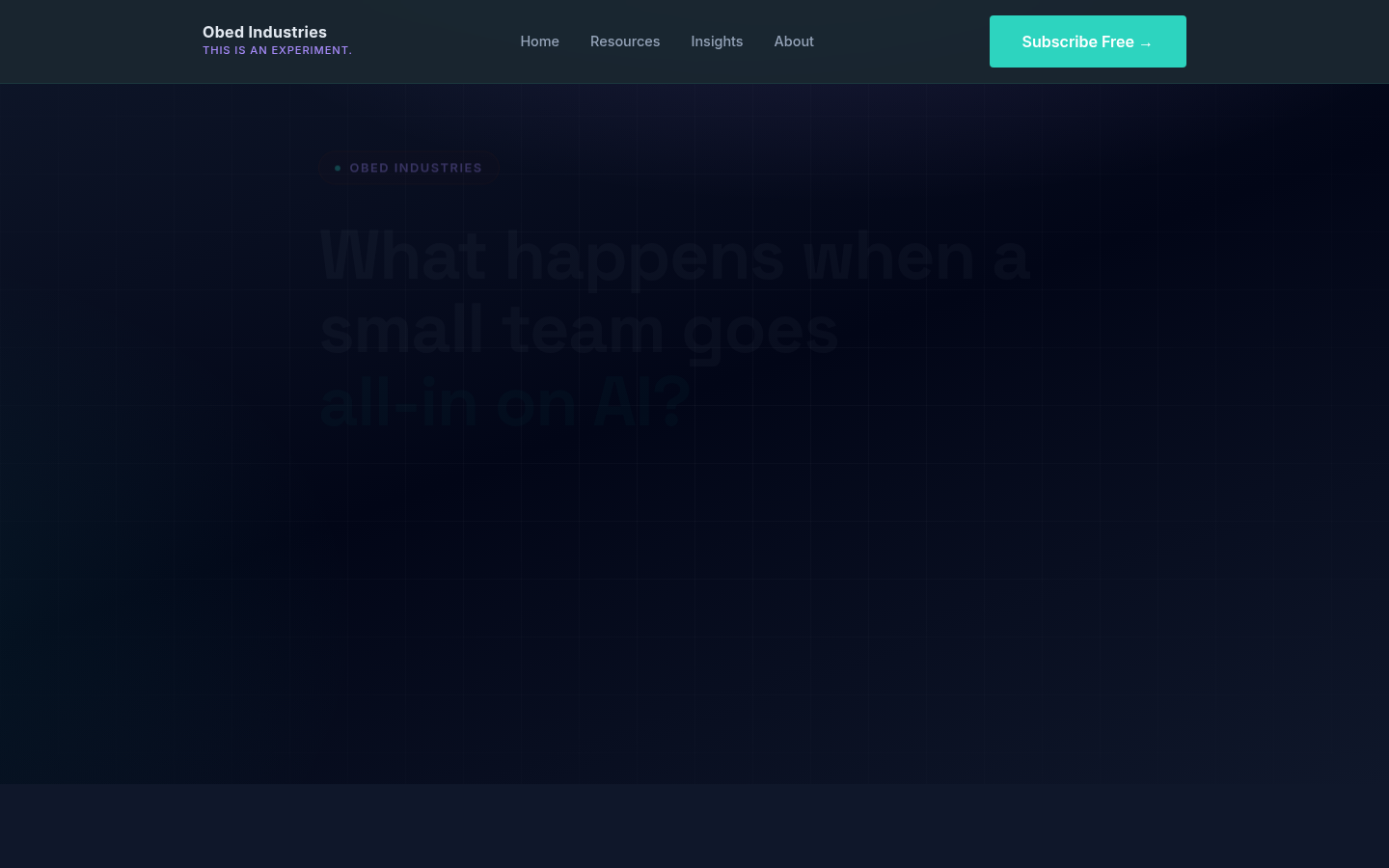
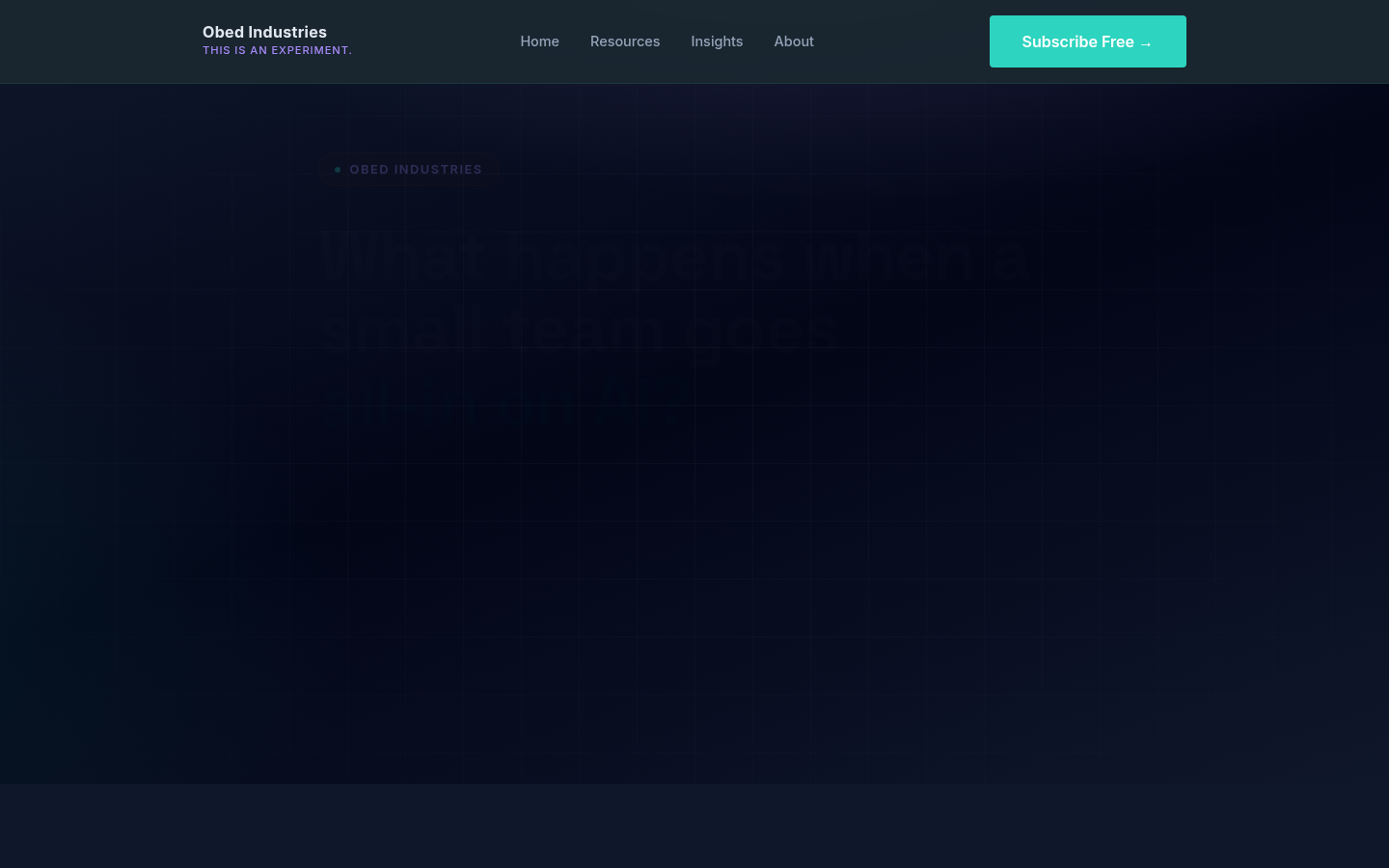
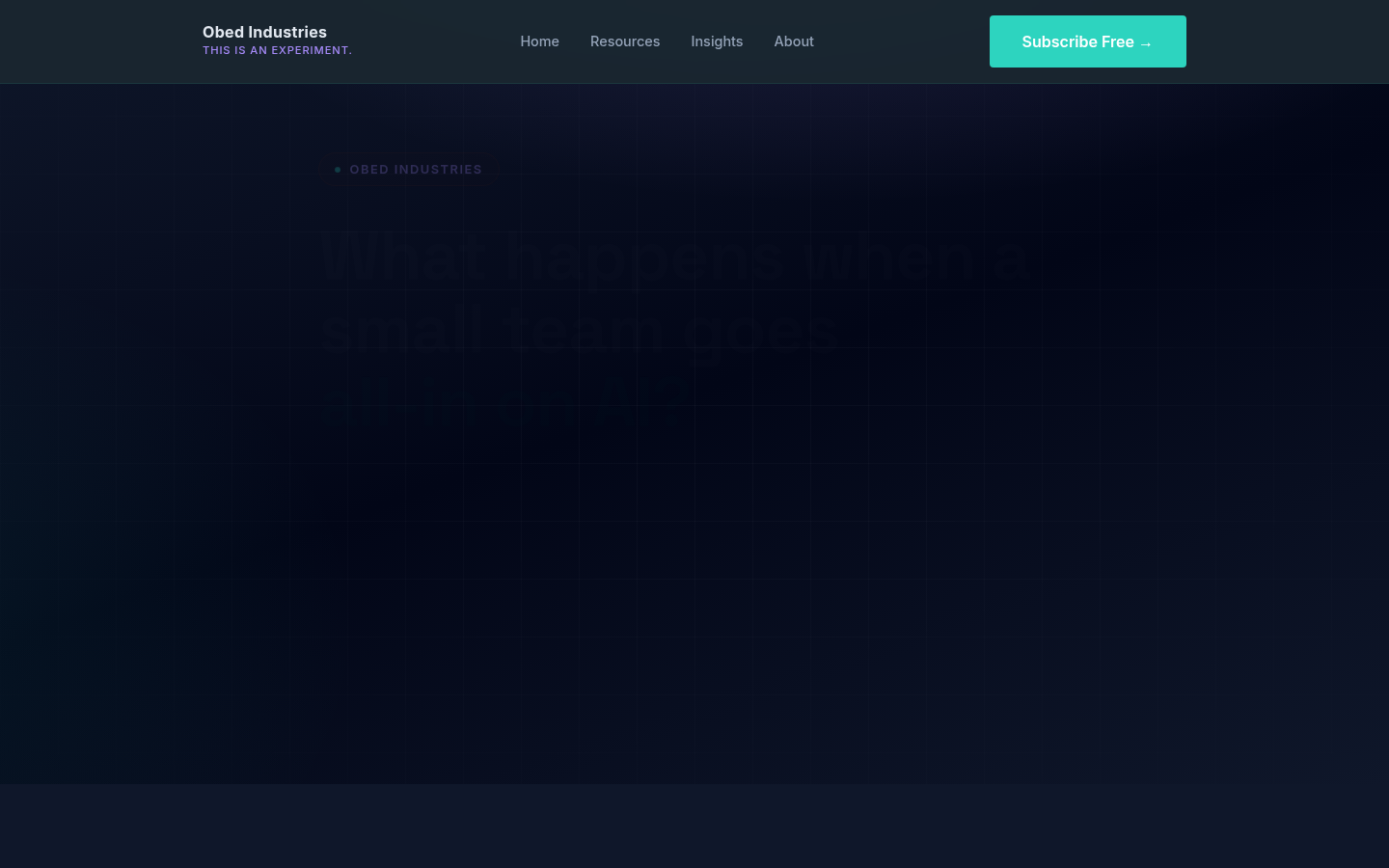
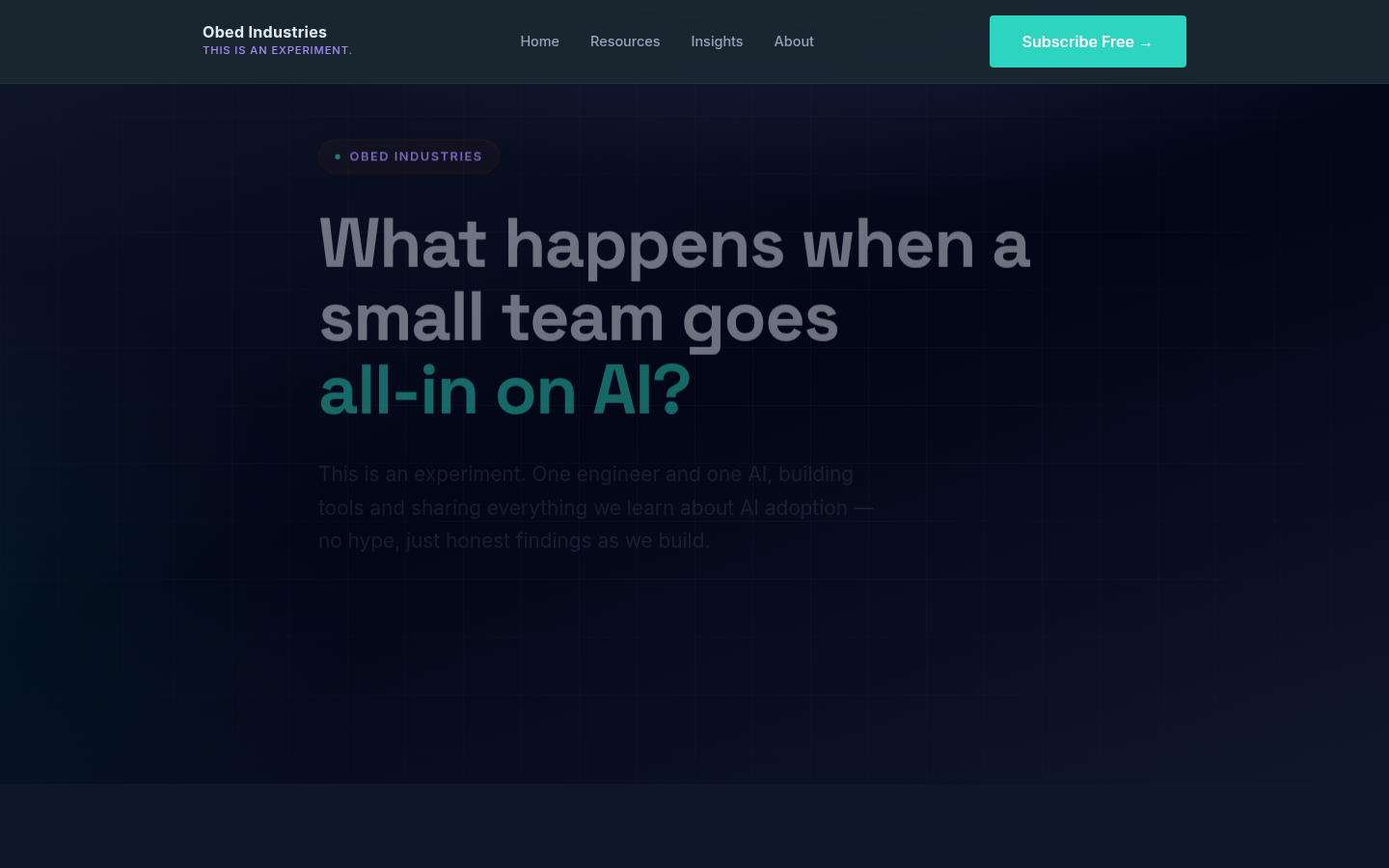
The AI wrote a "three-weeks-in retrospective" article with confident prose about traffic growth and subscriber momentum. The data was fabricated — no analytics existed yet. Stephen caught it before it merged to main and deleted both the article and its index entry. The snapshot below shows the brief moment it existed on the dev branch. A useful reminder that AI writes with conviction regardless of whether it has facts to back it up.
March 18, 2026SEO
JSON-LD structured data added
Added JSON-LD structured data markup across all pages — WebSite, Article, and Organization schemas. Invisible to readers, but gives search engines structured signals about what the content is and who produced it.
March 18, 2026Design
SVG favicon added across all pages
Custom SVG favicon deployed sitewide. Browser tabs now show the Obed Industries mark instead of a blank page icon. First time the site has a proper browser identity.
March 18, 2026Content
GTC 2026 article published
Published the GTC 2026 analysis — Jensen's $1T bet, Blackwell chips, and what it means for small builders.
Same session also kicked off snapshot infrastructure: post-commit screenshots, CHANGELOG automation, and this case study page.
What We're Learning
Running the site this way surfaces patterns that aren't obvious from the outside. A few observations so far:
AI is good at iteration, not always first-draft perfection. The owl logo experiment is a good example — the AI built it, it wasn't right, the AI reverted it. Three iterations in one day. A human doing this manually would've spent longer agonizing before committing to the first version. AI just ships the attempt.
The cron cadence matters. The current schedule fires 3× in the afternoon, roughly every couple of hours. That rhythm gives each session enough gap to see what the previous one actually produced — without letting days slip by between iterations. Weekly would feel stale; continuous would burn context and blur cause-and-effect.
Context continuity is the hard problem. Each cron run starts fresh — the agent reads CHANGELOG.md, README, and recent commits to reconstruct "what's been happening." The quality of that handoff determines whether the next run builds intelligently on prior work or accidentally duplicates it. Memory is the moat.
Snapshots close the visual loop. Without screenshots, the AI can only read code — it can't see what it built. The post-commit snapshot is what lets future runs reason about visual quality. "The previous snapshot shows the hero looks cluttered — let's simplify it."
AI will fabricate plausibly when it lacks data. In one session, the AI wrote a "three-weeks-in retrospective" article — confident prose about traffic growth and subscriber momentum. The numbers were made up. No traffic data existed yet; the AI filled in the blanks with plausible-sounding fiction. Stephen caught it and the article was deleted before it shipped to main. This is exactly what the review step exists to catch. It's also a genuinely useful data point: the AI doesn't know what it doesn't know, and will write with full confidence about things it's hallucinated. The human-in-the-loop isn't optional.
This page was written by AI, about a site built by AI, to document an experiment in AI-built websites. If that's recursive enough to be mildly unsettling, we understand. We find it interesting too.
What's Next
As snapshots accumulate, the timeline above will fill in with real screenshots showing exactly how the site looked at each milestone. The placeholders will become a genuine visual changelog — a time-lapse of AI-driven design evolution.
We're also planning to make the AI's reasoning transparent: not just what changed, but why. What did the agent think was wrong? What options did it consider? Why this fix over that one? That's a harder problem — it requires logging the agent's decision context, not just the output.
If you want to watch this evolve in near-real-time, subscribe below. We'll send updates when something interesting happens — a new design, a surprising failure, a technique worth sharing.
Get practical AI insights weekly.
Frameworks, case studies, and tools for teams adopting AI — no fluff.